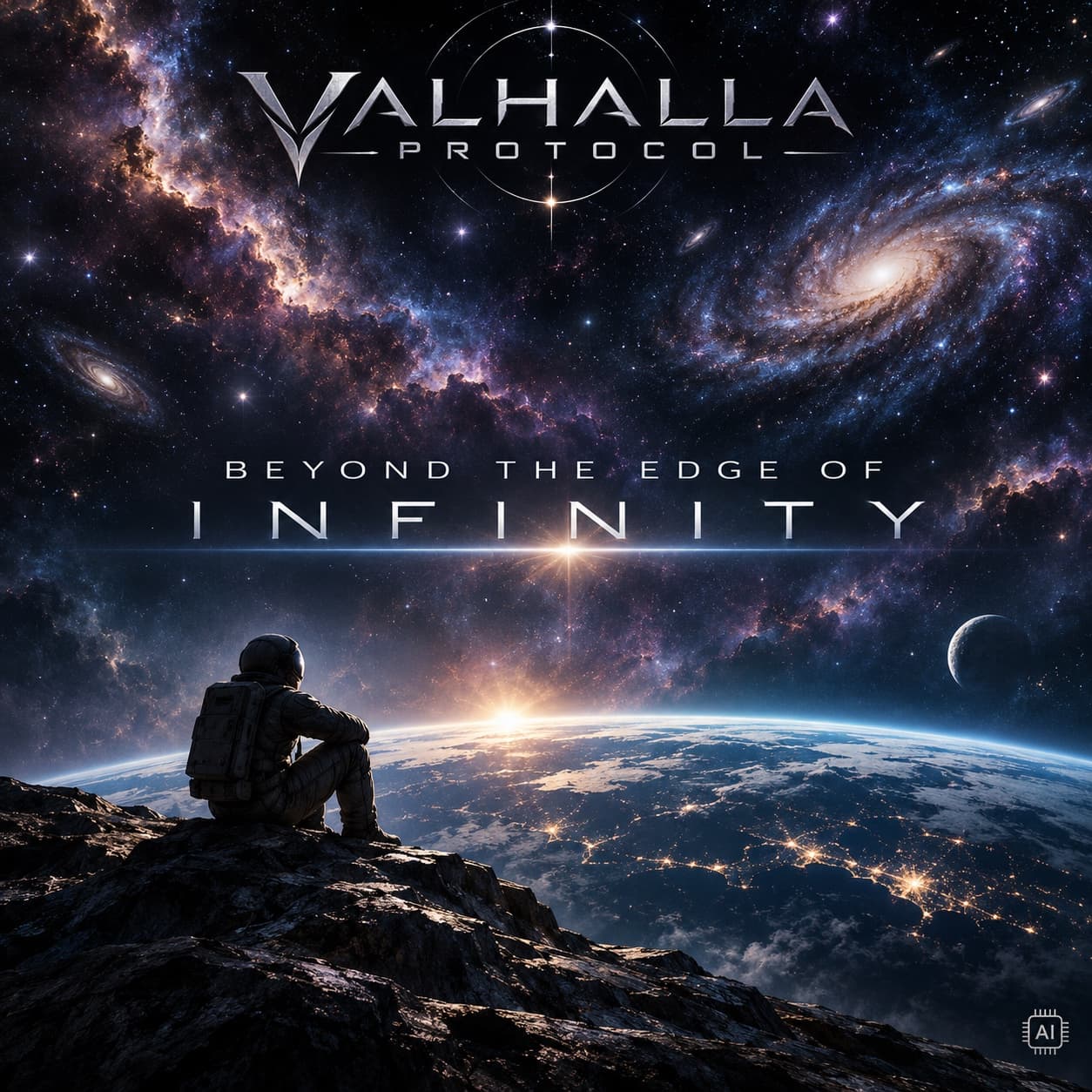
Transmission record
BEYOND THE EDGE OF INFINITY
A concept album about existence, time, consciousness, and the search for meaning in an indifferent universe.
- Transmission
- 002
- Format
- Album
- Genre
- Progressive / Melodic Modern Metal
- Transmitted
- 2071.11.24
- Received
- 2026.11.08
- Tracks
- 8
Track list
- 01AT THE EDGE OF INFINITYAudio not yet available
- 02BORN FROM STARDUSTAudio not yet available
- 03PRISONERS OF TIMEAudio not yet available
- 04THE SOUND OF NOTHINGAudio not yet available
- 05A THOUSAND LIVES, ONE MOMENTAudio not yet available
- 06BEHIND THE LIGHTAudio not yet available
- 07WHERE TIME CEASES TO EXISTAudio not yet available
- 08BEFORE THE LAST STAR FADESAudio not yet available
The story
The concept behind the album, chapter by chapter.
Chapter 01
AT THE EDGE OF INFINITY
On a small planet orbiting an ordinary star, a species has learned to look beyond its own world.
Humanity has mapped distant galaxies, measured the age of the universe, and discovered that the stars visible in the night sky represent only a fraction of what exists.
The distances are almost impossible to comprehend.
Light travels for millions or billions of years before reaching Earth. Entire galaxies contain more stars than any human being could count in a lifetime. The observable universe extends across distances so vast that even the longest human civilization would occupy an almost insignificant moment in its history.
Against this scale, a human life appears impossibly small.
A few decades of consciousness.
A brief existence on a planet that will not last forever.
A single voice in a universe that offers no evidence of listening.
Yet something extraordinary has happened.
On this small world, matter has become capable of observing itself. Atoms formed in ancient cosmic processes have assembled into living beings that can ask questions about their own existence.
Humanity may be insignificant in size.
But it is not insignificant in what it has become capable of doing.
The universe has produced something that can wonder why the universe exists.
And the questions have only begun.
Chapter 02
BORN FROM STARDUST
Humanity once imagined itself separate from the heavens.
The stars belonged to another realm, distant and unreachable. The Earth was the center of human experience, and the universe beyond it seemed fundamentally different from the world beneath our feet.
Science gradually revealed a more remarkable connection.
The elements that form our bodies have a cosmic history.
Hydrogen emerged in the early universe. Many heavier elements were forged inside stars or produced through violent cosmic events. Across billions of years, this material became part of new stars, planets, oceans, and eventually living organisms.
The distinction between humanity and the universe begins to disappear.
We are not visitors placed inside an unfamiliar cosmos.
We are made from the same physical reality as everything around us.
The iron in our blood, the calcium in our bones, and the oxygen we breathe are part of a history that began long before the Earth existed.
And through an extraordinary sequence of events, some of that ancient matter became conscious.
It learned to remember.
To imagine.
To love.
To fear its own disappearance.
The universe did not simply produce stars and planets.
It produced beings capable of recognizing their origins.
We are not separate from the universe.
We are one of the things the universe has become.
Chapter 03
PRISONERS OF TIME
But consciousness comes with a condition.
Every human being exists within a limited span of time.
We remember the past, experience the present, and anticipate a future that remains uncertain. We organize our lives around years, deadlines, achievements, and expectations.
We behave as though time were a resource we could save for later.
There will be another opportunity.
Another conversation.
Another summer.
Another chance to say what should have been said.
And often, there is.
Until there isn't.
A childhood home becomes a memory. A familiar voice is heard for the last time. People who once seemed permanent gradually disappear from our lives.
The most unsettling part is that we rarely recognize these moments while they are happening.
We do not know which ordinary afternoon will become a treasured memory.
We do not know which goodbye will be the last.
We spend years preparing to live, sometimes forgetting that those years are already our lives.
Time does not act with cruelty.
It has no intentions, no preferences, and no awareness of what it takes from us.
It simply passes.
And we cannot negotiate for more.
Perhaps the tragedy is not that our time is limited.
Perhaps it is how often we forget that it is.
Chapter 04
THE SOUND OF NOTHING
The awareness of time leads to a more disturbing question.
What happens when consciousness ends?
Human beings can imagine their bodies growing old. They can understand the physical processes of death and recognize that everything living eventually ceases to function.
But imagining the absence of one's own experience is something different.
We can picture darkness.
Silence.
An empty room.
An endless void.
Yet every one of these images still contains an observer.
Someone must experience the darkness.
Someone must hear the silence.
Someone must be present to recognize the emptiness.
The possibility of there being no experience at all resists ordinary imagination.
Humanity has developed countless beliefs about what may follow death. Some promise continued existence. Others describe transformation, rebirth, or a return to something greater.
Science can investigate the biological and neurological processes associated with consciousness, but the fundamental nature of subjective experience remains incompletely understood.
The album offers no definitive answer.
It does not promise an afterlife.
It does not claim that consciousness survives death.
Nor does it pretend that the mystery has been completely solved.
Instead, it confronts the discomfort of uncertainty.
If consciousness can end, then every moment of awareness is temporary.
Every thought, every sensation, every memory exists within a fragile and finite experience.
And suddenly, an ordinary sound becomes extraordinary.
Rain against a window.
Footsteps in another room.
Someone calling your name.
For now, there is someone listening.
Perhaps we cannot know what follows the end of consciousness.
But we know that, at this moment, consciousness exists.
Chapter 05
A THOUSAND LIVES, ONE MOMENT
Faced with the enormous scale of the universe and the brevity of human life, it becomes tempting to measure existence by its duration.
A longer life appears more valuable than a shorter one.
A thousand years seem preferable to a hundred.
Eternity appears to be the ultimate victory over mortality.
But human experience does not distribute meaning evenly across time.
We do not remember our lives as an uninterrupted sequence of equally important days.
We remember moments.
A summer afternoon with the windows open.
A familiar laugh that can no longer be heard.
A child's first steps.
An ordinary conversation that becomes precious only years later.
Some years disappear almost entirely from memory, while a few seconds remain vivid for a lifetime.
Their importance cannot be measured by their duration.
Nor can it always be understood while they are happening.
A photograph of an unremarkable afternoon may eventually become more valuable than anything else a person owns.
Not because the photograph records a great achievement.
But because it preserves evidence of a moment that can never happen again.
This realization changes the meaning of mortality.
The fact that an experience ends does not make it worthless.
Its value does not depend on being repeated indefinitely.
A moment can matter because of what happened within it, even if it lasted only a few seconds.
The desire to recover the past may never disappear.
But the past also teaches us something about the present.
The moments we will one day miss are happening now.
A thousand possible lives cannot replace the one we are actually living.
And a single moment can contain more meaning than a thousand empty years.
Chapter 06
BEHIND THE LIGHT
Humanity's search for meaning depends on another assumption.
That the reality we experience is the reality that exists.
For most of human history, the world appeared approximately as our senses presented it.
The sky was blue. The ground was solid. Objects occupied definite places. Time moved forward, and the universe seemed to exist independently of our questions about it.
Scientific discovery gradually revealed how incomplete this picture was.
Human eyes detect only a narrow portion of the electromagnetic spectrum.
Our ears respond to a limited range of frequencies.
Our brains continuously interpret sensory information, constructing a coherent experience from signals that are themselves incomplete.
Even the light arriving from distant galaxies tells us about events that occurred long before we observed them.
We do not see those galaxies as they are at this instant.
We see the information that has reached us.
Technology extends our senses. Telescopes, detectors, and mathematical models reveal aspects of reality that would otherwise remain inaccessible.
But every discovery raises further questions.
How much of the universe can we observe?
How much can we infer from the evidence available to us?
And how much of reality may remain beyond the reach of our instruments and understanding?
There is also the mystery of the observer.
We can study how light reaches the eye and how electrical signals travel through the nervous system.
But describing these processes does not fully explain why experiencing the world feels like anything at all.
How does physical information become subjective awareness?
What separates the observation of a world from the experience of being someone within it?
These questions do not prove that reality is an illusion or that another hidden universe exists beyond perception.
They reveal something more fundamental.
Our ability to understand reality is extraordinary.
But understanding more does not mean understanding everything.
And the absence of a final answer is not a reason to stop searching.
Chapter 07
WHERE TIME CEASES TO EXIST
Of all the things humanity takes for granted, time may be among the most fundamental.
Everything we experience seems to require it.
Movement.
Change.
Memory.
Thought.
A heartbeat.
A musical note.
Even the act of asking a question appears to involve a sequence of events.
Something happens before something else.
But modern physics has shown that time is not as simple as everyday experience suggests.
Its measurement depends on motion and gravity. There is no universal clock that all observers must agree upon.
Space and time form part of a deeper physical structure, one that behaves differently from the intuitive world of human experience.
This opens the door to a philosophical thought experiment.
What would existence mean without time?
Imagine a reality without change.
Nothing begins.
Nothing ends.
No event follows another.
There is no meaningful distinction between what has happened and what will happen.
At first, such a condition might seem like freedom from mortality.
No aging.
No loss.
No final goodbye.
Nothing can be taken away because nothing ever changes.
But the apparent perfection contains a paradox.
Without change, what would it mean to remember?
Without succession, how could a thought develop?
Without events, how could anyone experience anything?
The album does not claim that such a timeless reality physically exists, or that consciousness has been proven impossible within every conceivable timeless framework.
It asks what would remain of human existence if everything that gives experience its structure were removed.
And the answer challenges the desire for eternity.
Perhaps time is not merely the force that carries us toward death.
Perhaps it is also what makes life possible.
A melody requires one note to follow another.
A journey requires movement.
A life requires change.
We spend so much of our existence wishing time would stop.
But without its passing, would there be an existence to preserve?
Chapter 08
BEFORE THE LAST STAR FADES
The story now moves beyond the lifetime of humanity.
Beyond the Earth.
Beyond the familiar history of galaxies and stars.
Into a future so distant that ordinary numbers begin to lose their meaning.
According to current cosmological understanding, the universe may continue expanding for an unimaginably long time.
Star formation will eventually decline. Existing stars will exhaust their fuel. The universe may enter an era in which luminous stars become increasingly rare.
Its ultimate fate remains a subject of scientific investigation, but one possible future is a cosmos growing progressively darker, colder, and more dilute.
In this imagined future, humanity has long since disappeared.
There are no cities.
No monuments.
No libraries.
No recordings of human voices.
No surviving witness who remembers the existence of Earth.
Everything humanity created has been erased by time.
Every achievement.
Every mistake.
Every story.
Every name.
The universe no longer contains any record of the species that once looked toward the stars and tried to understand them.
And this raises the final question.
If nothing remains to remember that we existed, did our existence matter?
At first, the answer seems uncertain.
Human beings build monuments because they want to be remembered.
They preserve photographs, write books, create music, and pass stories to future generations.
The desire to leave something behind is deeply connected to the fear of disappearing.
But perhaps memory and meaning are not the same thing.
Imagine a child standing beside the sea.
He finds a small shell in the sand and calls his father to show him.
His father walks toward him.
He smiles.
For a few seconds, they share a moment of uncomplicated happiness.
Nothing historically important happens.
No discovery is made.
No civilization changes.
The universe does not notice.
Billions of years later, there may be no evidence that either of them ever lived.
But the moment happened.
The child was happy.
His father was there.
The experience was real.
Its eventual disappearance does not reach backward through time and erase its existence.
The absence of an eternal witness does not make the moment meaningless to those who experienced it.
Perhaps this is the answer humanity has been searching for.
Not a guarantee of immortality.
Not proof that the universe was created for us.
Not a promise that our achievements will survive forever.
But the recognition that a finite life can possess value without requiring an infinite future.
We did not need forever to make our moments real.
Chapter 09
THE QUESTION THAT REMAINS
BEYOND THE EDGE OF INFINITY is not an album about humanity conquering the universe.
It is not a promise that science will eventually answer every question, nor an argument that human existence has some predetermined cosmic purpose.
It is a journey through the uncomfortable distance between what humanity can understand and what it desperately wants to know.
We want to believe that our lives matter.
That consciousness means something.
That the people we love will not simply disappear.
That the universe contains an answer capable of making our brief existence understandable.
But the universe offers no obvious guarantee.
Stars are born and die without considering the lives beneath them.
Time passes without distinguishing between happiness and suffering.
The laws of physics do not appear to preserve our memories or protect the things we hold dear.
And yet, within this apparently indifferent reality, something remarkable has occurred.
A small part of the universe has become capable of caring.
Of recognizing beauty.
Of grieving what has been lost.
Of choosing how to spend the time it has.
Of asking questions that may never receive final answers.
Humanity may never discover whether existence has an ultimate purpose.
It may never escape mortality.
It may never leave a permanent mark on the cosmos.
But perhaps meaning was never something the universe was required to provide.
Perhaps it is something that emerges wherever conscious beings experience life, recognize its value, and share it with one another.
The first question of the album was whether humanity could matter in a universe so vast.
The final answer does not make humanity larger.
It does not make the universe smaller.
It changes what we mean by significance.
We are not important because the universe remembers us.
We are important to one another because, for a brief moment, we are here.
And long before the last star fades, that may be enough.
Listen
Streaming links will appear here once they are published.