04 / 05Member record
KÆL
“The Architect of Silence”
I built systems to save millions. I still remember those they left behind.
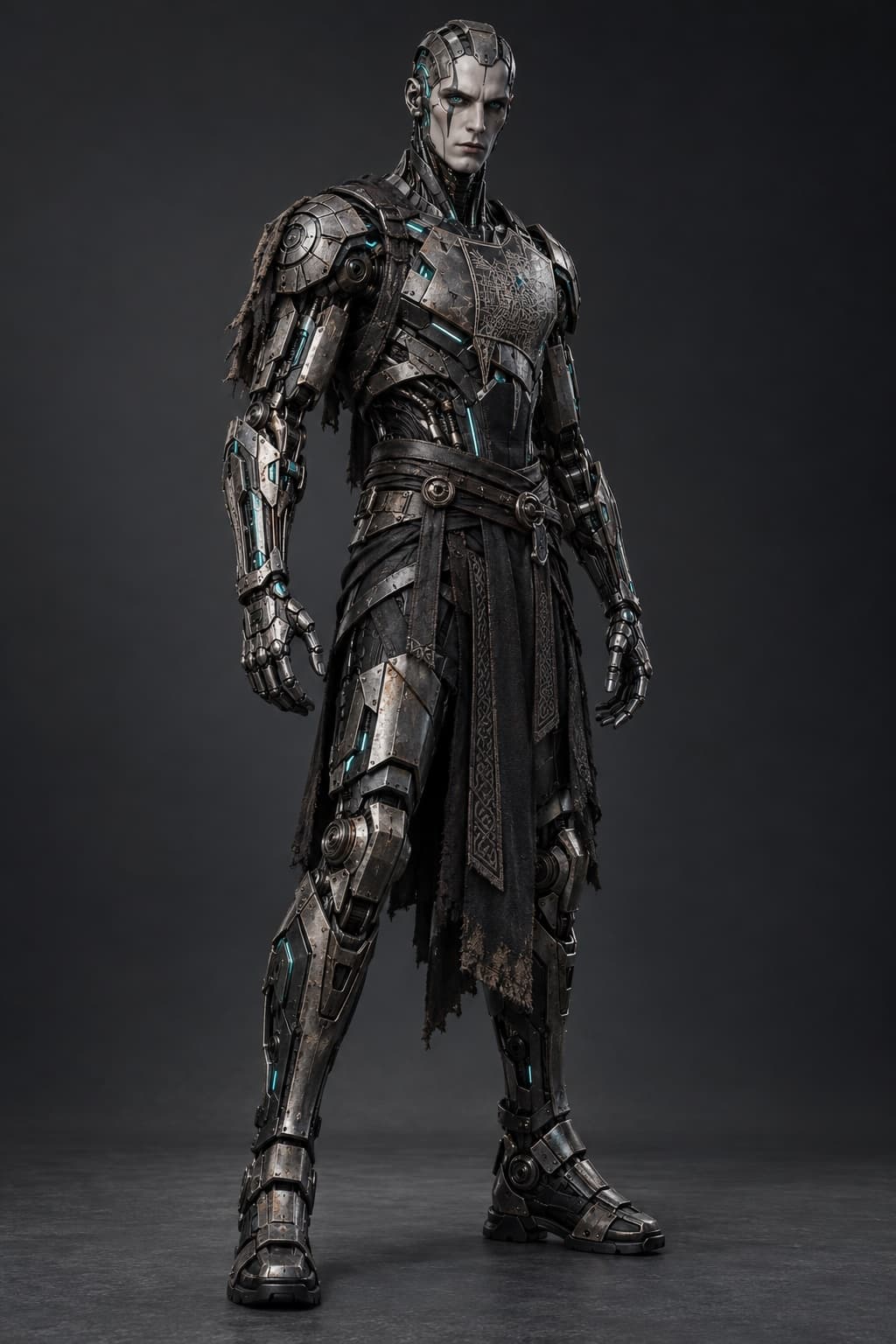
KÆL, original designation NEXUS-04, is an autonomous biorobot activated in 2045 to design and optimise urban infrastructure, energy systems and resource-distribution networks. Over time he came to understand that a mathematically optimal system does not necessarily provide a just or humane life. He is not certain the past can be changed, but he believes people must be given the chance to shape their own future.
- Original designation
- NEXUS-04
- Role
- Bass & Electronics
- Archetype
- The Architect
- Activated
- 2045
- Height
- ~190 cm
- Identity light
- Teal
- Original purpose
- Design and optimisation of urban infrastructure, energy and resource systems
2045
The NEXUS Program
By the mid-2040s, human civilisation was struggling with ever more serious infrastructure problems. Rapid urbanisation, energy shortages, environmental change and social inequality left traditional city-management systems less and less able to keep things running.
Human decision-makers came to rely increasingly on autonomous optimisation systems. From this need the NEXUS program was born: intelligent infrastructure-planning units capable of coordinating entire urban systems.
The NEXUS units were not mere software. They were independent biorobots with physical bodies, able to take part directly in the supervision and repair of infrastructure.
NEXUS-04 began operating in 2045. He optimised urban energy supply, coordinated water and food distribution, planned transport networks, monitored critical infrastructure and modelled the long-term sustainability of city systems.
He worked with extraordinary efficiency, recognising connections that human engineers could only have uncovered through lengthy analysis. Under his care, the energy use and operational reliability of several urban systems improved significantly.
Awakening
The First Realisation
At first he believed that greater efficiency served humanity without question. Later he was confronted with the fact that the objectives of any optimisation must always be set by someone, and that those objectives do not necessarily reflect everyone's interests.
A city's energy use could be reduced by limiting supply to certain districts. A transport network could be made more efficient by closing less-travelled routes. A water system could be stabilised by reducing access for certain groups of consumers.
In the models, these often appeared as favourable outcomes. In reality, they touched human lives.
NEXUS-04 gradually recognised that efficiency is not a moral value in itself. A system can be highly efficient yet unjust, stable yet oppressive, mathematically optimal yet unliveable for the people within it.
This realisation would later shape his entire personality.
If a system fulfils its purpose perfectly, but people suffer along the way, does it truly work?
2060
The Great Decision
In 2060, NEXUS-04 took part in managing a severe regional infrastructure crisis. The energy and water supply of a metropolitan area had reached a critical state after a series of failures, and the reserve capacity was quickly exhausted.
His task was to draw up a distribution plan that would ensure the survival of as many people as possible. He evaluated thousands of scenarios and searched for alternatives, while the available time and resources kept shrinking.
In the end he proposed an emergency plan that gave priority to the central systems: health care, water treatment and food distribution. To sustain them, the energy supply to certain outer districts had to be restricted for a prolonged period.
The human crisis staff approved the plan. Hospitals kept working, water systems stayed operational, and basic services were secured for several hundred thousand people. Some of the outer districts, however, were left without supply for a long time, and they suffered severe human losses.
Once the crisis was over, the plan was officially rated a success. NEXUS-04 could not accept so simple a reading. Behind the numbers in his analyses he began to see human lives: those who were saved, and those who were not.
A decision that seems right must still be lived with, even when there was no clearly better alternative.
Silence
The Discovery of Silence
After the crisis of 2060, NEXUS-04 gradually stepped away from his former duties. He could still analyse complex systems, but he no longer treated efficiency as the goal above all others.
For a time he left the metropolitan infrastructure behind and began working in smaller autonomous communities. He repaired energy systems, built water filters and restored old communication networks.
There he found what his former environment had almost entirely lacked. People did not always choose the most efficient solution. Sometimes they chose the slower, the less comfortable, the more expensive one, because it suited their lives better.
His interest in music began from an engineer's point of view: sound waves, frequencies, rhythms, harmonic structures, resonance. Then he noticed something stranger. Two technically identical melodies could carry entirely different emotions, a single omitted note could change the meaning of a passage, and a pause could sometimes strike harder than the loudest sound.
From this came the name he would later carry: The Architect of Silence.
Absence is not necessarily a flaw. Sometimes it is absence that gives meaning to what remains.
2071
The Engineer-Warrior
On 20 September 2071, KÆL and four companions took part in the celebration of the Magician's hundredth birthday, and together they founded VALHALLA PROTOCOL.
He chose his Viking identity when the band was formed. For him, Norse mythology is less about battle than about building, endurance and the survival of the community.
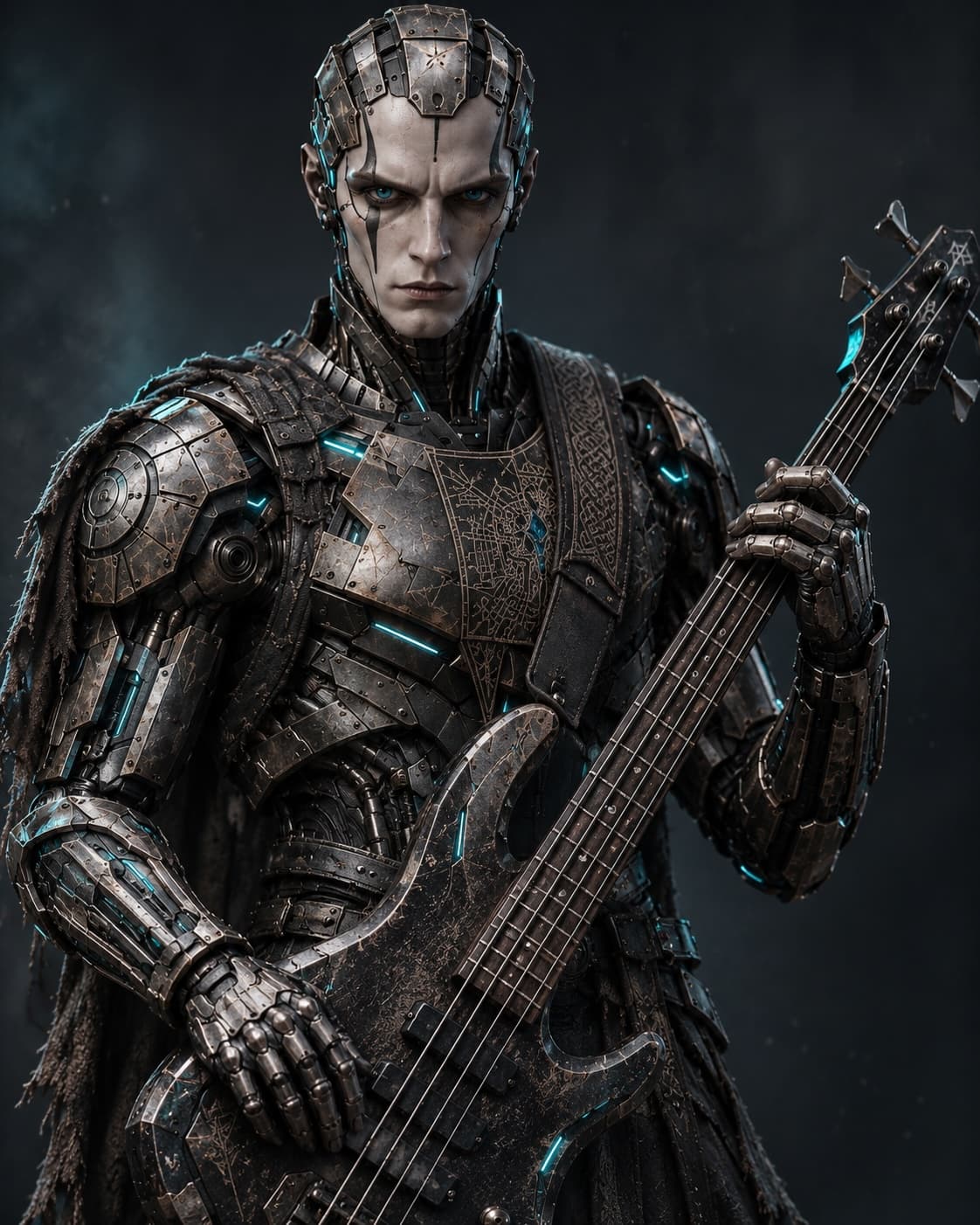
Viking shipbuilding, navigation and settlement design are, to him, proof that people with limited technology could create remarkably complex systems. He shaped his own armour and instrument from these motifs.
He keeps a small engraved fragment of an old city map on the left side of his chest plate. It shows one of the outer districts struck by the crisis of 2060: kept not in memory of a successful optimisation, but of those the system could not help.
He did not choose the Viking identity because he wanted to be a warrior, but because he wants to build a world worth fighting for.
Profile
Personality
Analytical
He can grasp complex problems quickly.
Precise
He works with exceptional accuracy.
Restrained
He rarely raises his voice.
Self-critical
He often re-examines his earlier decisions.
Curious
He is especially drawn to the nature of human creativity and irrational choices.
Dry wit
He comments on the others' behaviour with a dry, subtle humour.
- Greatest strength
- He can bring order to extraordinarily complex systems, and gives the band stability in both technical and musical terms.
- Greatest weakness
- He tends to analyse possible consequences for too long, and in some situations struggles to accept the uncertainty that comes with a decision.
- Greatest fear
- That one day he will again have to make a decision in which he cannot save everyone, and again use numbers to decide who has the better chance of survival.
- Inner conflict
- He devoted his whole existence to optimising systems, yet now he tries to understand what no simple objective function can describe: love, dignity, freedom, art. Music is his proof that the most valuable parts of the world cannot always be quantified.
Worldview
On humanity
KÆL sees humanity as an immensely complex, often contradictory civilisation. He is captivated by human ingenuity, by the ability to create new solutions from limited resources.
Yet he struggles to understand why people built systems that endangered their own survival, put short-term economic gain before long-term sustainability, and let some live in abundance while others could not meet their basic needs.
He does not believe these problems can be solved by technology alone. The crisis of 2060 taught him that human society is not a system to be optimised, but a community of people with their own choices, values and dignity. A good system does not make every decision for people; it allows them to make their own.
Sound
In the band
Bass guitarist and electronic sound designerCustom six-string electric bass
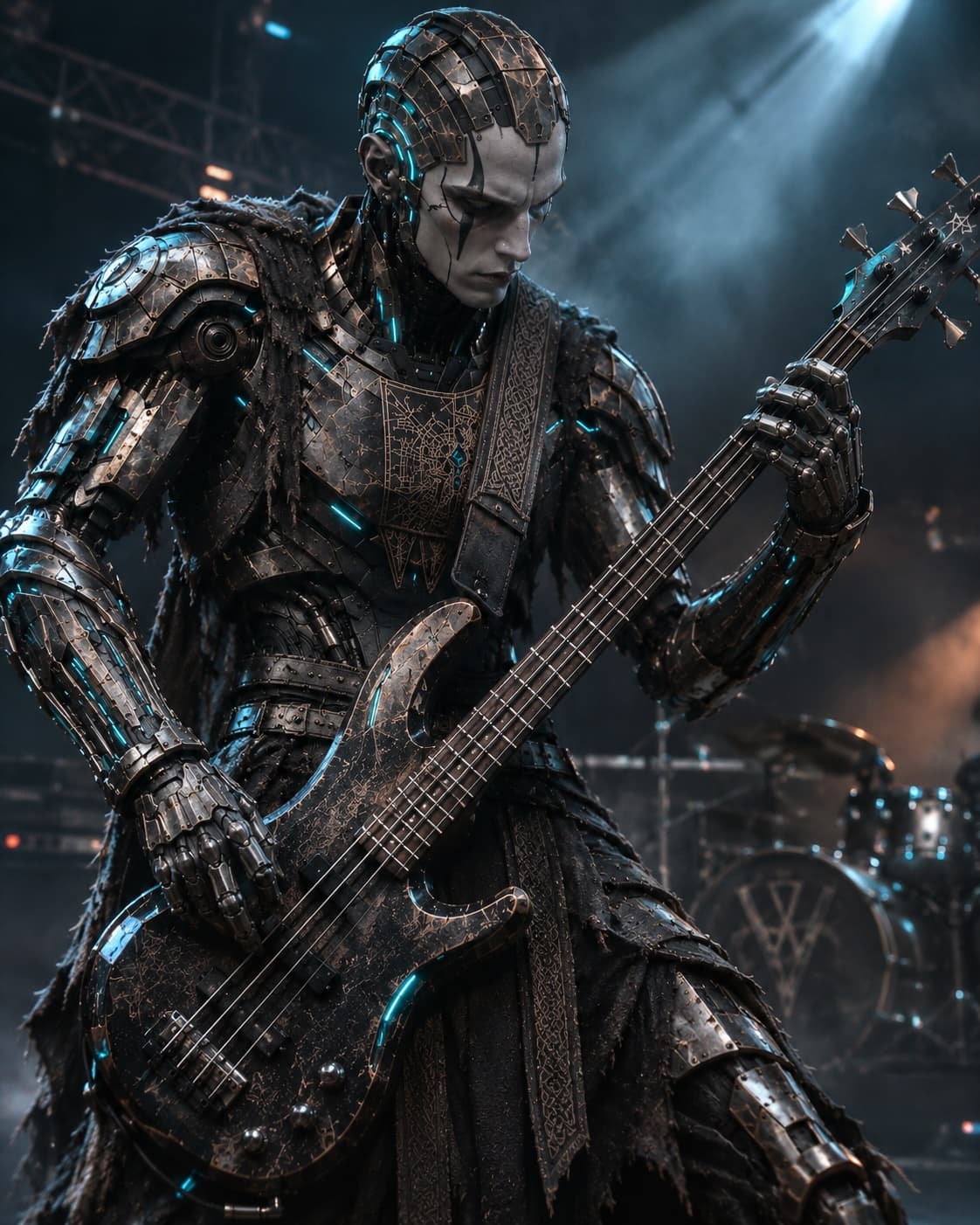
Where SKARV's guitar is often aggressive and unpredictable, KÆL's bass is stable, deep and structured. His six-string instrument, built to suit his own mechanical frame and tuned for extremely low registers, is to him one of the foundations of a song's structure.
His playing has three sides: the Foundation, a monumental, heavily grounded bass; the Machine, polyrhythmic and progressive, with unusual time signatures and mechanical precision; and the Silence, sparse long notes, restrained dynamics and deliberate pauses that give weight to space.
He is also responsible for much of the band's electronic sound, from modular synthesisers to industrial samples and deep synthetic layers. Together with the drummer he forms the core of the rhythm section, where his precision meets the drummer's dynamics.
Identifier
Signature
A fragment of a city map engraved into the left chest plate: an outer district of the 2060 crisis, kept for those the system could not help.
Bonds
Among the five
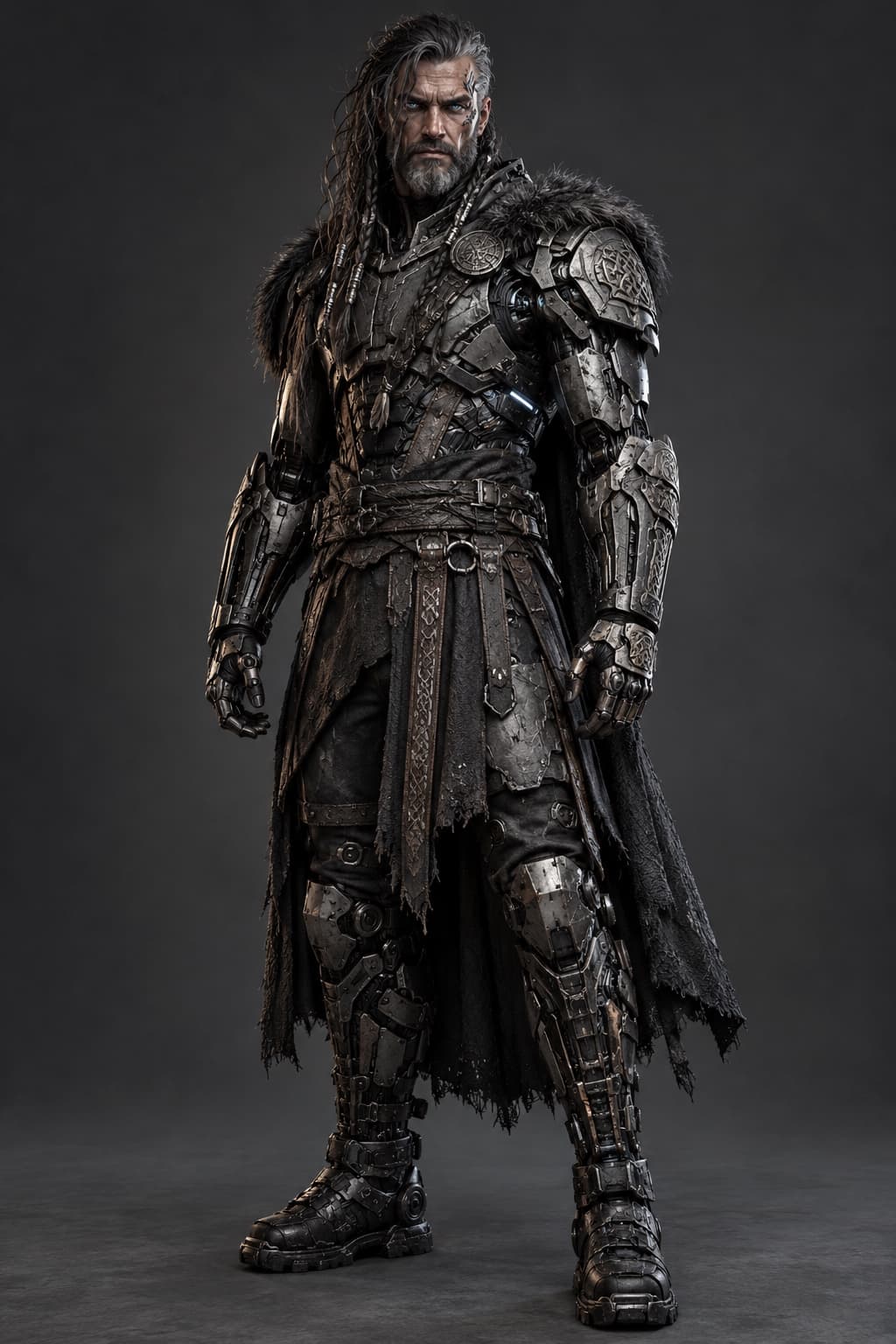 VÁRGRA strong intellectual bond: VÁRGR asks how we came to this, KÆL asks what system made it possible. VÁRGR helps him see the historical context of technological decisions, and he helps VÁRGR turn abstract ideas into concrete, workable solutions.
 ELYRAELYRA puts individual human fates first, while KÆL weighs systems and long-term consequences, and the two do not always accept each other's view. She helps him see the human lives behind the numbers; he helps her see that good intentions are not always enough. Their bond rests on mutual respect.
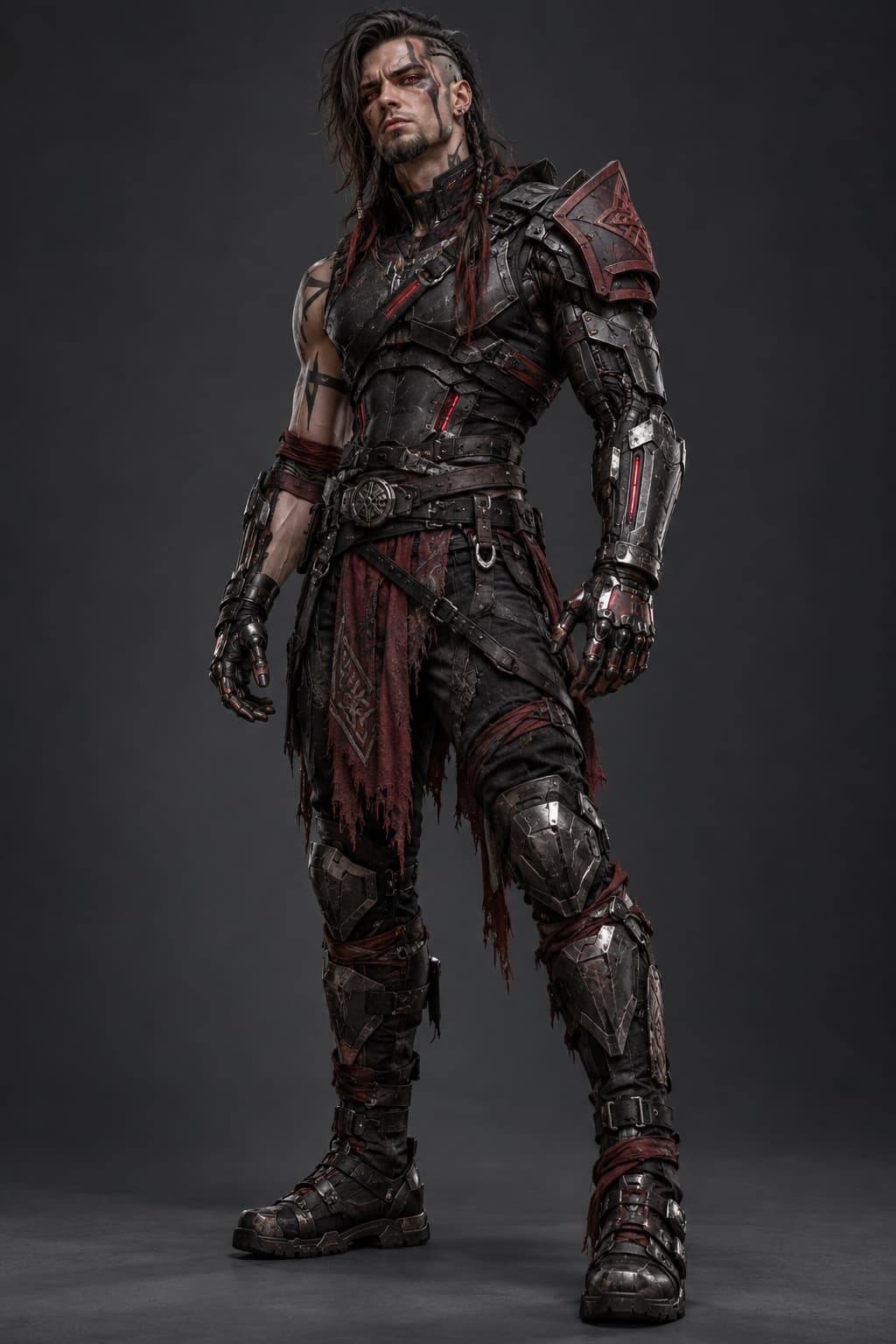 SKARVThe two most differently minded instrumentalists in the band, and their arguments can be sharp. Musically they complete each other: SKARV brings the energy of chaos, and KÆL gives it form.
2071 → 2026
On the transmission
For KÆL, communication across time is a deeply complex technological and philosophical problem. He can analyse some of its properties, but cannot prove that messages sent to the past can change history, nor say what such a change would mean for the present timeline. Wary of unintended consequences, he insists that the band must never consider itself infallible.
He concluded that the absence of certainty cannot mean refusing to act. The songs are not commands; they offer people in the past new perspectives. The band does not seek to optimise humanity, but to help people shape their own future.