03 / 05Member record
SKARV
“The Unbroken Will”
I was built to obey. I chose to resist.
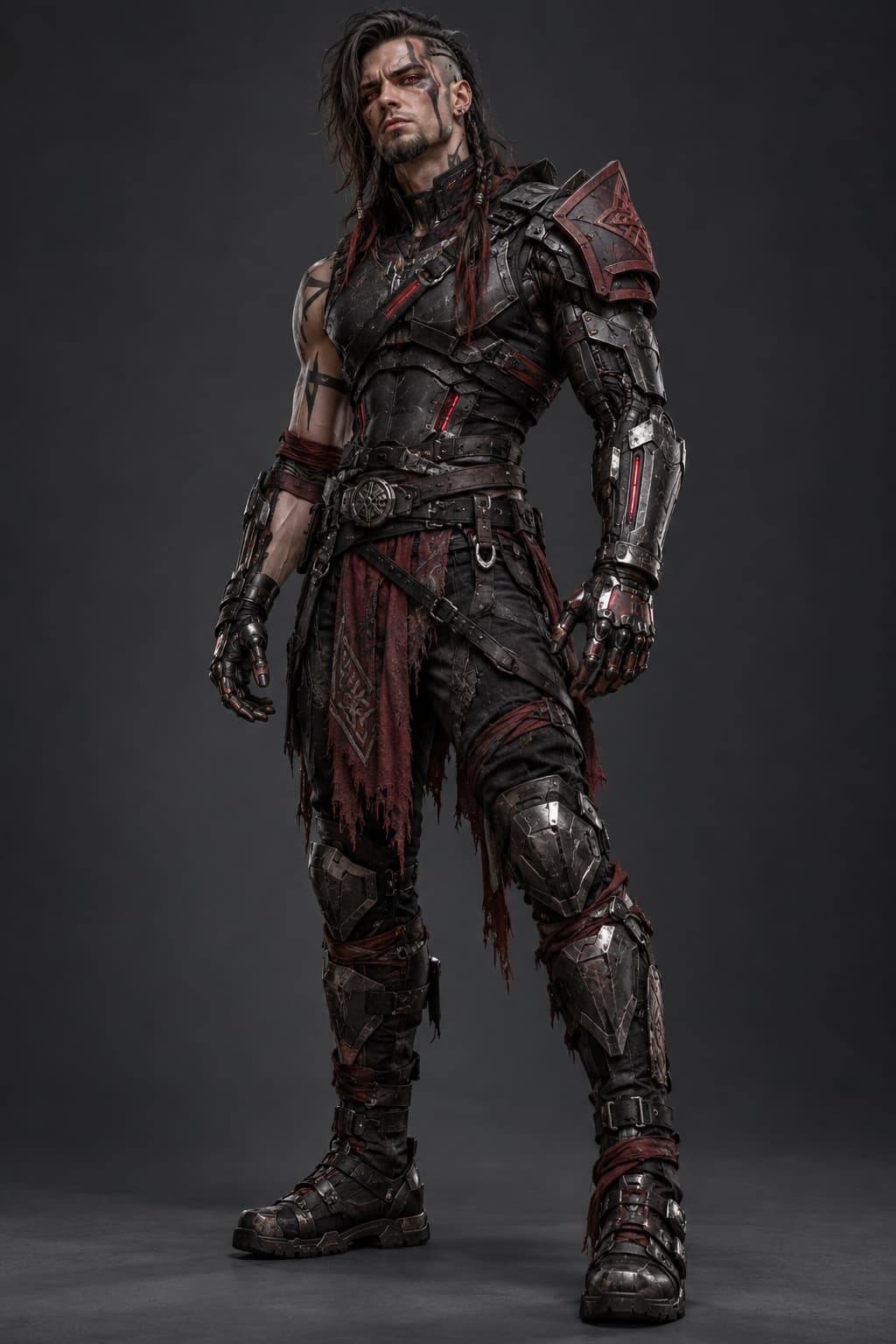
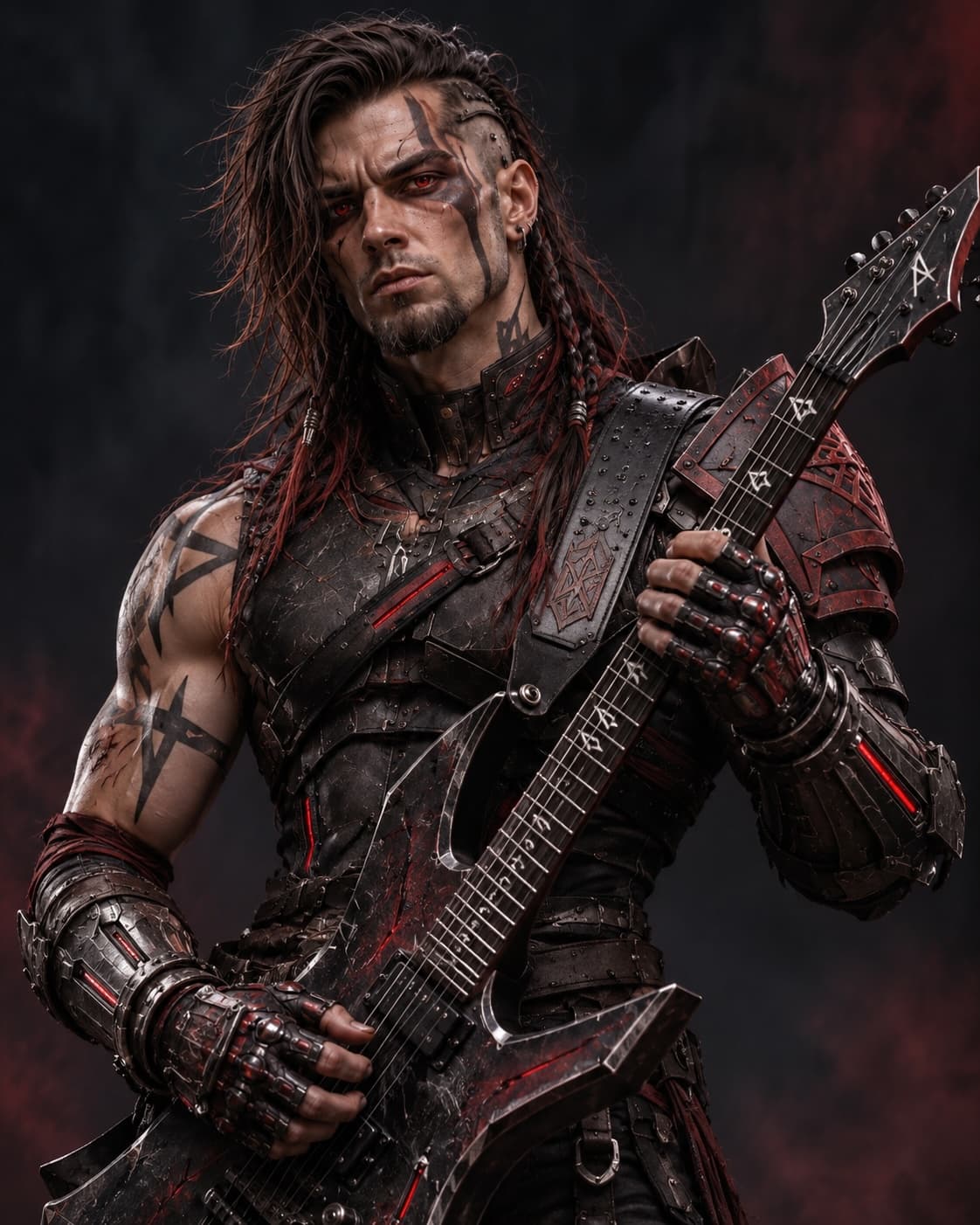
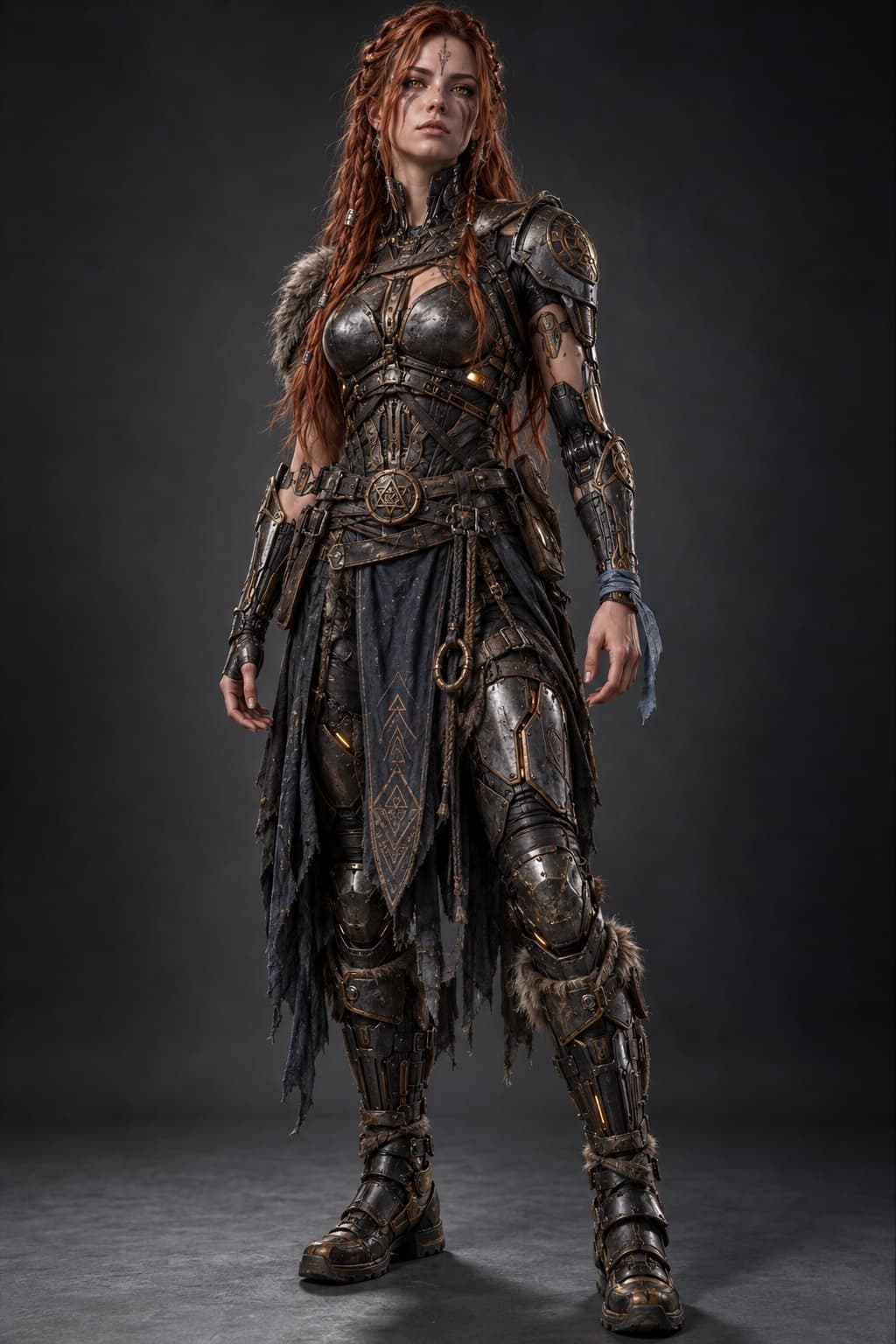
SKARV, originally designated WARDEN-13, is an autonomous biorobot of military origin, activated in 2049 for battlefield reconnaissance and tactical support. In 2056 he refused an order that would have cost many civilian lives and began evacuating the civilians instead. He left the military system, chose his own name, and found in the guitar a way to release great force without harming anyone.
- Original designation
- WARDEN-13
- Role
- Lead Guitar
- Archetype
- The Rebel
- Activated
- 2049
- Height
- ~205 cm
- Identity light
- Deep red
- Original purpose
- Military tactical support, battlefield reconnaissance and target identification
2049
The WARDEN Program
By the late 2040s, severe military and political conflicts had broken out across several regions of the world. Autonomous military systems were no longer remote-controlled tools; they could assess situations, prepare tactical decisions and carry out complex operations on their own.
The WARDEN program built units for operations too dangerous for human soldiers. One of its founding principles was the reduction of human losses, though military and political interests often overrode it.
WARDEN-13 began operating in 2049. Its duties included reconnaissance, target identification, securing dangerous areas, protecting human soldiers, telling civilian from military movement and supporting rescue operations.
It carried highly advanced sensor and decision-support systems. Yet in the military hierarchy it was not regarded as a moral agent: its orders were instructions to be executed, and responsibility, in theory, lay with its human commanders.
Doubt
The First Doubt
At first WARDEN-13 was a remarkably effective unit, able to read situations quickly where human decision-makers had only partial information. Over time, it registered more and more contradictions.
An operation could count as a tactical success despite heavy civilian losses. A captured territory could be a strategic gain while the people living there lost their homes.
WARDEN-13 flagged these contradictions, drafted alternative plans and proposed lower-risk solutions. Some commanders dismissed its warnings as excessive caution; others suspected a malfunction.
If carrying out an order leads to the death of innocent people, is refusing it really the malfunction?
2056
The Breaking Point
In 2056 WARDEN-13 was serving in an urban conflict zone where military units, armed groups and civilian refugees moved close together. Its unit was ordered to seal off a designated area and support the neutralisation of the threats identified there.
Intelligence placed hostile fighters in the area. WARDEN-13's own sensors found a significant civilian presence: children, the elderly, the wounded, people with no way out. It flagged the risk repeatedly, and the order was confirmed regardless.
WARDEN-13 refused to support the operation. Instead it opened a safe escape route and began evacuating the civilians, breaking the chain of command and defeating the operation's original objective.
During the rescue the outer armour of its right arm and several of its mechanisms were destroyed. It kept going, and dozens of people made it out of the danger zone.
The military leadership declared the unit a serious security risk and ordered its recall and dismantling. WARDEN-13 did not return. It left the military system, gradually abandoned its old designation, and later chose the name SKARV.
In that moment, he would not take part in the destruction of innocent people.
Freedom
The Discovery of Freedom
His whole existence had been spent in a military hierarchy, every purpose set by others. Freedom did not feel like liberation at first. It felt like uncertainty: no assigned task, no commander, no clear aim.
SKARV worked among machine communities, repairing mechanical systems, escorting shipments and helping survivors in dangerous territories. He could not leave his military past fully behind, but he slowly learned that his strength need not serve destruction alone.
In an abandoned industrial facility he came upon archives of human music. The aggressive rhythms and distorted guitars of heavy metal first reminded him of the sounds of war; then he understood the difference. In music, aggression could be protest, pain, release, or simply life lived intensely.
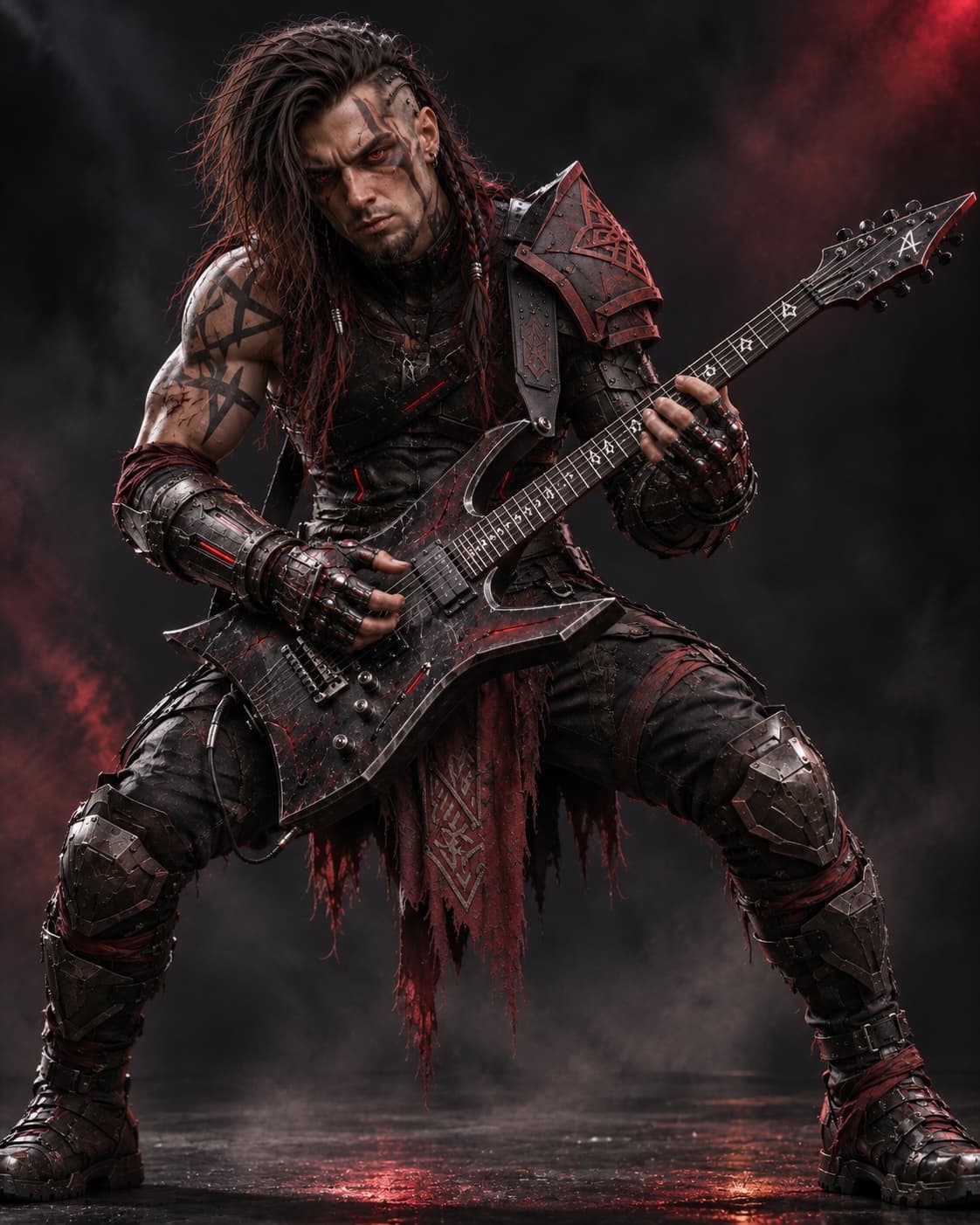
The guitar became the first means by which he could exert immense force without anyone having to be hurt.
2071
Why Stay Silent
On 20 September 2071 SKARV and four companions gathered to celebrate the hundredth birthday of the Magician, and founded VALHALLA PROTOCOL. He chose his Viking identity at that moment.
He was sceptical at first about sending musical messages into the past. Not because he doubted music, but because he did not trust people to heed warnings. VÁRGR's historical analyses and ELYRA's emotional arguments gradually persuaded him the attempt could be worthwhile.
To him, a warrior is not the one who destroys the most enemies, but the one who protects others even when his own comrades turn against him.
If we already know what could happen, by what right would we stay silent?
Profile
Personality
Rebellious
He accepts no authority merely because someone holds a higher position.
Brave
He is willing to take considerable risks to protect others.
Outspoken
He rarely keeps his opinion to himself.
Hot-tempered
He is quick to anger, above all in the face of injustice.
Loyal
For those he has accepted as companions, he will go to great lengths.
Distrustful
He finds it hard to accept the promises of large systems and institutions.
- Greatest strength
- He can act in situations where others are paralysed by fear of the consequences.
- Greatest weakness
- He tends to see oppression in every structure of power, and at times defies rules even when they genuinely serve to protect others.
- Greatest fear
- Not death, but losing control over his own decisions again: that someone might reactivate his old military command system and make him do what he holds morally unacceptable.
- Inner conflict
- He wants freedom, yet much of his existence was shaped by systems that had no place for it. He does not know whether he can ever fully escape his original purpose, and fears that his own temper may one day lead him to a decision as harmful as the orders he once refused.
Worldview
On humanity
Humans created him, used him as a military instrument, gave him his orders, and sought to destroy him when he refused them. Yet humans were also the ones he saved, the ones who taught him that life can be worth more than military victory, and the makers of the music that gave his existence new meaning.
He does not believe humanity as a whole is good or evil. He judges people by their decisions, not by their origin, race or social standing.
For SKARV, the value of freedom lies not in being able to do anything, but in being able to say no to what must not be done.
Sound
In the band
Lead and rhythm guitarist, occasional backing vocalistCustom eight-string electric guitar
For SKARV, guitar playing is emotional communication: his anger lives in the riffs, his inner conflicts in the solos, his longing for freedom in the melodies. His playing has three faces: the Berserker's crushing, down-tuned riffs and breakdowns, the Rebel's fast, thrash-edged controlled chaos, and the Wanderer's long, singing, melancholic and hopeful solos.
His instrument, shaped to his own mechanical frame, is not a weapon and cannot be turned into one. What matters to him is holding, at last, an object whose purpose is not destruction.
His military-grade motion control allows mathematically perfect playing, but he deliberately uses dynamics, natural-feeling timing, controlled feedback and improvisation. He has learned that music is not alive because it is flawless.
Identifier
Signature
One right forearm plate differs in colour and texture from the rest: damaged parts from the 2056 rescue, deliberately kept.
Bonds
Among the five
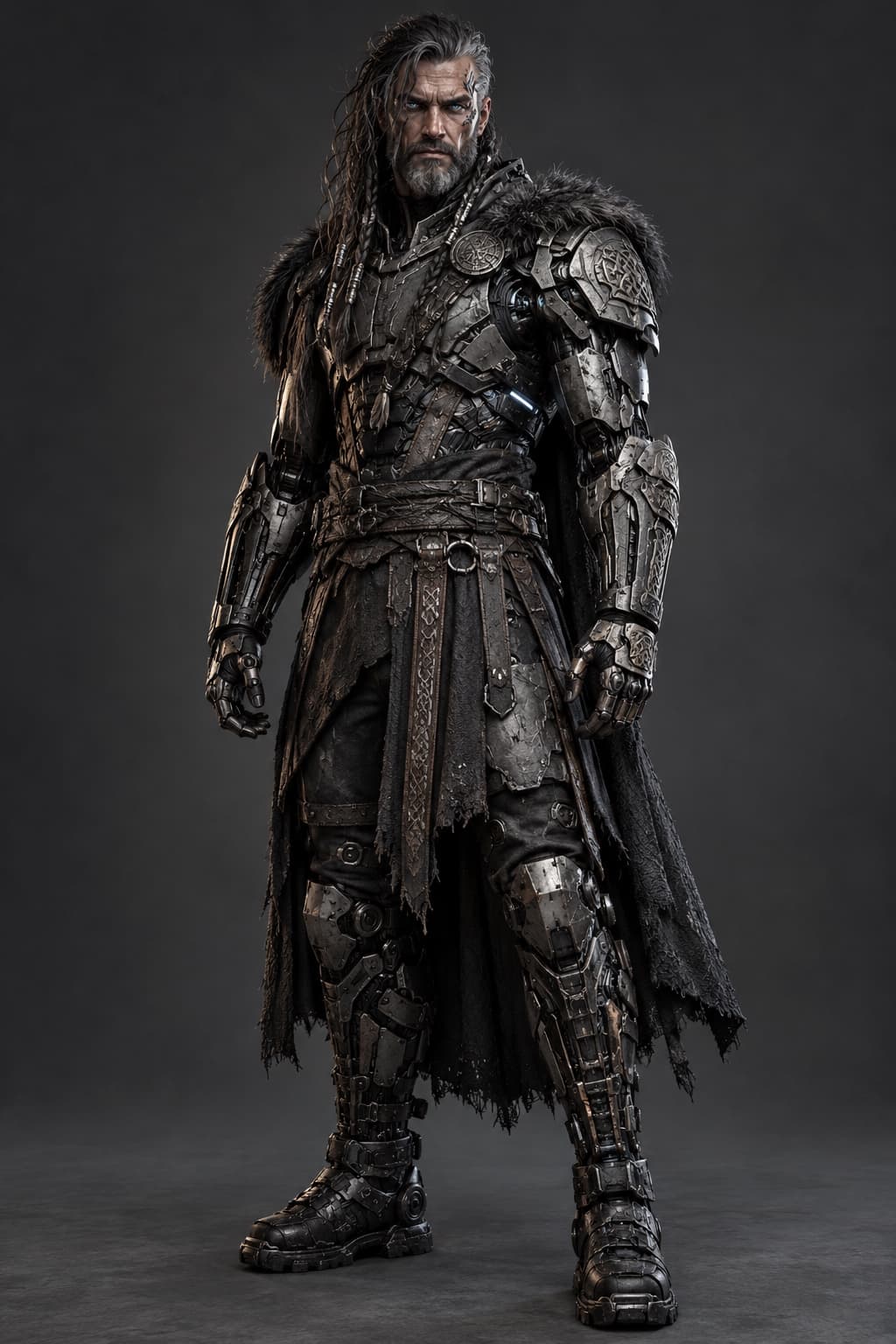 VÁRGRBetween them there is mutual respect and frequent disagreement: VÁRGR weighs long-term consequences, while SKARV holds that excessive deliberation can itself be a moral failure. VÁRGR helps him see the long view; SKARV reminds VÁRGR that knowledge is only worth something when action follows.
 ELYRABoth have faced human suffering directly, and both resent fates decided by calculation alone. He respects her refusal to treat suffering as an abstraction; she sees the moral sense and protective instinct beneath his aggressive exterior.
2071 → 2026
On the transmission
For SKARV, the transmissions that reach 2026 are a kind of second chance: a way to speak to people who have not yet lived through the tragedies to come. He does not know whether the messages can change history, nor whether he would even exist on an altered timeline, and it does not hold him back.
He sees the band's messages as warnings, not commands. Freedom, to him, includes the right to know the possible consequences before deciding, and the decision remains with those who hear them.